The biggest mistake we see with new short-let landlords is not declaring properly. HMRC has had a data-sharing agreement with Airbnb since 2020 and, since 2024, with every other major platform. They know what you earned. The only question is whether you declared it.
This is the 2026 tax guide for London short-let landlords. Covering what to declare, how it's taxed, what's changed since the abolition of the FHL regime, and the structural decisions that have the biggest impact on your effective tax rate.
This is general guidance only. Tax is complex and circumstances vary. Consult a qualified accountant before making decisions.
Do I need to declare?
Yes. Always. Income from short-letting your property via Airbnb, Booking.com, Vrbo, Expedia or direct is taxable income. There are two narrow exceptions:
- The Rent-a-Room scheme: if you let a furnished room in your own main residence, the first £7,500 of income per tax year is tax-free
- The £1,000 trading allowance: if total miscellaneous income is below £1,000 in a year, no declaration is required
Anyone earning more than £1,000 from short-letting a property they do not live in must declare it via Self Assessment.
How short-let income is taxed
Income from short-letting a property is treated as rental income. Property Income on the SA105 Self Assessment supplementary page. It is taxed at your marginal rate: 20%, 40% or 45%.
Allowable expenses are deducted from gross income to arrive at taxable profit. The main deductions for a Central London short-let:
- Management fees (our 18% management fee is fully deductible)
- Platform fees taken by Airbnb / Booking.com / Vrbo
- Cleaning costs per turnaround and deep cleans
- Utility bills paid by the landlord
- Linen, consumables and welcome packs
- Insurance (specialist short-let policies)
- Maintenance and minor repairs
- Mortgage interest (subject to the residential restriction. 20% tax credit only)
The 2025 FHL abolition, and what it means now
Until 5 April 2025, properties meeting Furnished Holiday Let (FHL) criteria enjoyed three meaningful advantages: full mortgage interest deductibility, capital allowances on furniture, and Business Asset Disposal Relief on sale.
As of 6 April 2025, the FHL regime no longer exists. Short-let properties are now taxed like any other rental. Meaning the residential mortgage interest restriction applies, and FHL-specific reliefs are gone.
Practically: if you bought a Central London short-let on a high-leverage residential mortgage and were relying on full interest deductibility, your effective tax rate is materially worse than it was in 2024. Many of our clients have moved financing into corporate structures (limited company ownership) since the announcement.
The £90,000 VAT threshold. London-specific risk
Short-let income is not exempt from VAT. It's a taxable supply. Once gross short-let income exceeds £90,000 in any rolling 12-month period, the landlord (or their limited company) must register for VAT and charge 20% on every booking.
In Mayfair, Marylebone and Knightsbridge, two-bed apartments routinely generate £150,000+ in gross short-let income. VAT registration is a real consideration.
The Tour Operators Margin Scheme (TOMS) can mitigate some of the VAT impact for managed short-lets, but it's structurally complex and the right answer depends on the property and the operator structure. Worth a conversation with an accountant if you're approaching the threshold.
Council tax vs business rates
A short-let property can in some circumstances be reclassified from council tax to business rates, provided occupancy thresholds are met (140 nights available, 70 nights actually let). For some smaller properties, Small Business Rates Relief means an effective rate of zero. Meaningfully cheaper than council tax.
2024 rule changes made this harder to achieve in practice. The Valuation Office Agency now scrutinises applications closely; HMRC and the VOA share data on short-let occupancy.
The 90-day rule and tax classification
London's 90-day rule interacts with tax classification in subtle ways. Properties used predominantly as short-lets (above 90 days, with planning permission) are typically classified as commercial for council tax / business rates purposes. Properties operating within the 90-night cap typically remain residential.
Mixing short-stay and mid-term lets keeps you on the residential side of this line. Operating compliantly within the cap matters for both regulation and tax.
The top five tax mistakes we see
- 01Not declaring at all. HMRC data is comprehensive. Penalties for non-disclosure can reach 100% of the unpaid tax, plus interest
- 02Treating Airbnb cleaning fees as non-income. Cleaning fees collected from guests are gross income. The cost of cleaning is a separate expense to deduct
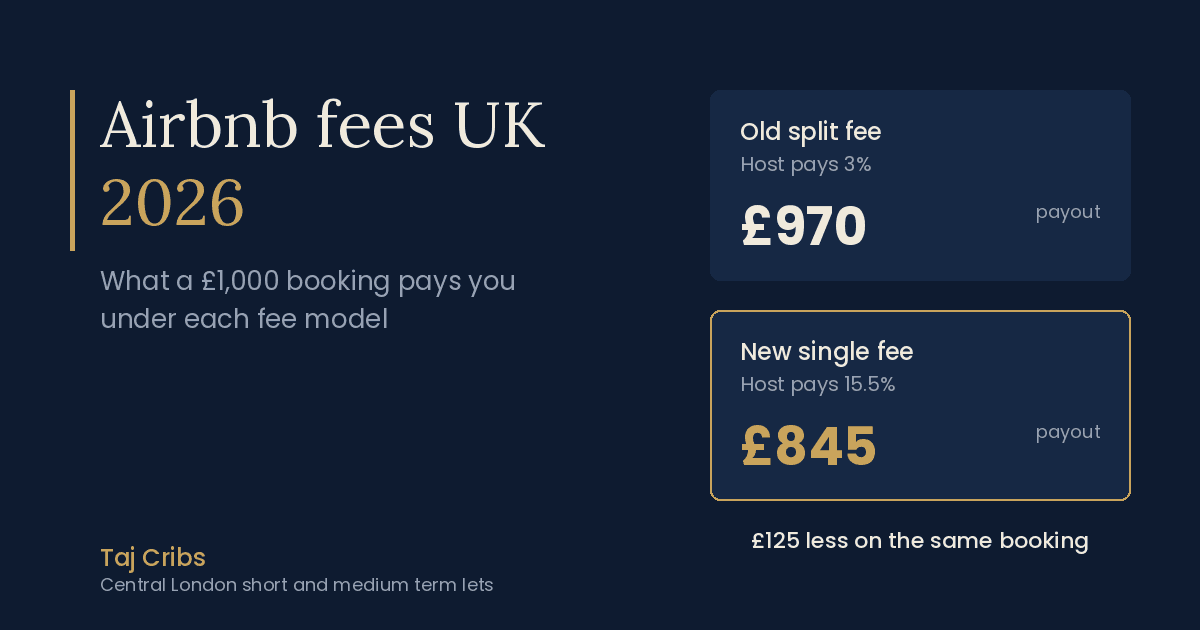
- 03Forgetting to deduct platform fees and management fees. Airbnb takes ~15% before payout; managers take 18% on top. Both are fully deductible
- 04Mishandling the 90-day rule. Exceeding 90 days without planning permission can reclassify the property for tax purposes
- 05Assuming FHL still applies. It does not, for any year ending after 5 April 2025
Structural decisions that make the biggest difference
Three structural choices have outsized impact on your effective tax rate:
- Personal vs limited company ownership. Post-FHL, limited company ownership is more attractive than it was, especially for highly leveraged properties
- Whether to bring the property under the VAT threshold via management structure (TOMS)
- Council tax vs business rates classification. Small properties with Small Business Rates Relief can save thousands annually
None of these are decisions to make on a blog post. They're conversations with a qualified accountant who knows the London short-let market.
Have a question about your property? Speak to the Taj Cribs team. We manage properties across the whole of Central London and offer free valuations with no obligation.
This article is general information only. Tax law is complex and individual circumstances vary. Landlords should consult a qualified accountant or tax adviser before acting on anything described here.